.png)
Introducing the Lean Manufacturing Agent

Squint's Lean Manufacturing Agent balances your production line by performing time and motion studies to optimize standard work, the floor layout, and staffing plans, with your constraints in mind.
Every process improvement project still starts the way it did in 1911: a stopwatch, a clipboard, and someone standing there watching. The study covers only the cycles your team has the capacity to study, it takes days to write up, and the line runs the old way until it's done.
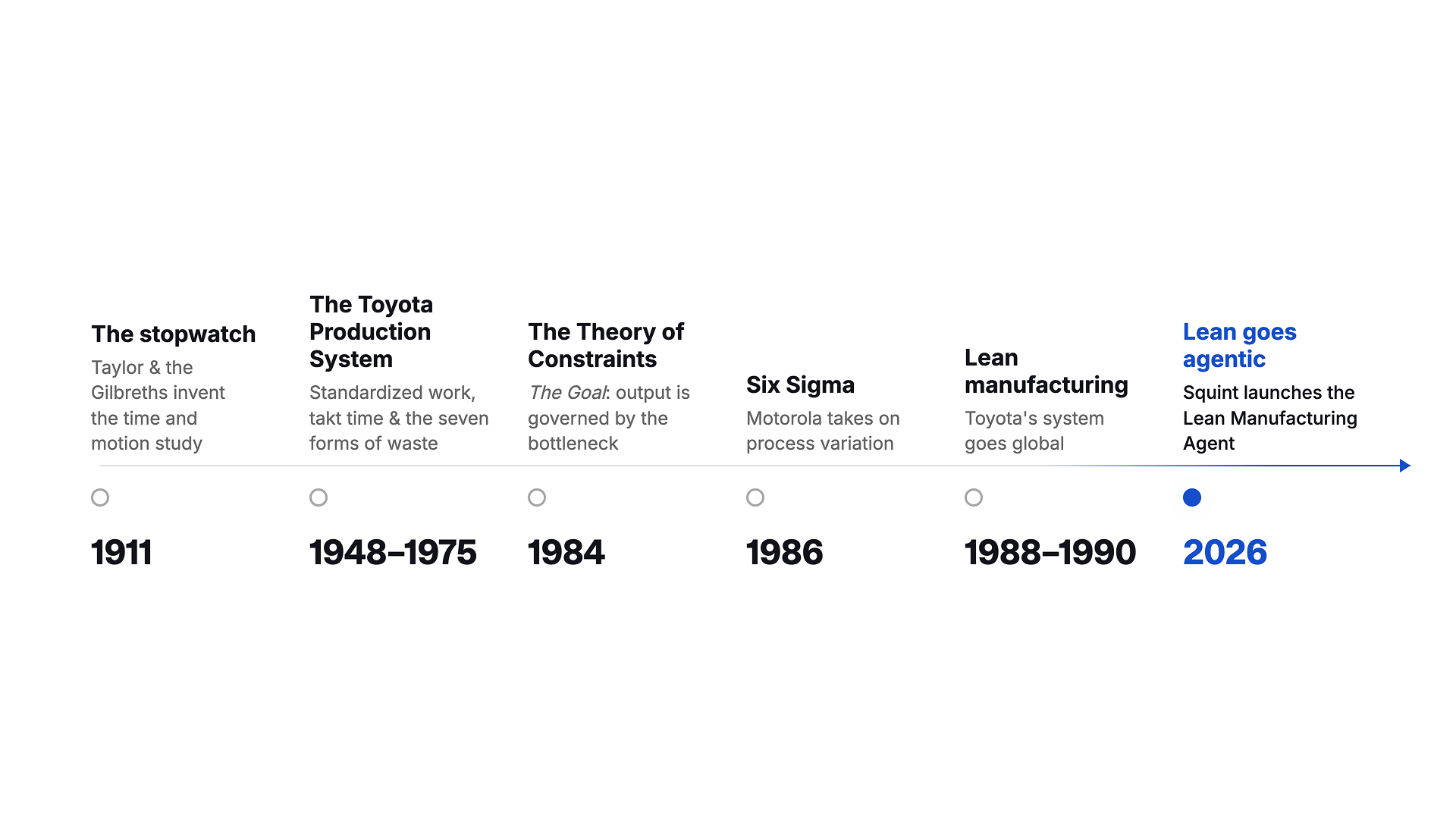
There have been significant revolutions over the last 100+ years in manufacturing. We’ve iterated on how processes are defined, measured, and optimized. But every approach has hinged on the same bottleneck: a trained expert with enough time to observe and analyze everything manually. The truth is, continuous improvement has never been continuous because it’s impossible to scale.
The station
Squint’s Lean Manufacturing Agent eliminates this bottleneck, because it automates observation, categorization, and foundational analysis. To see how, we'll follow along as the agent works— just like a lean engineer walking a plant. It starts at a single station, observing a single process, then it zooms out to the line, then to the whole plant.
Record one cycle of real work using a phone, head-mounted camera, or the camera already hanging over the line. No narration. No setup. No stopwatch.
Upload the video, and the agent returns a gapless time and motion study. Here’s what it does:
- Classifies every second — value-added, necessary non-value-added, or one of the seven forms of waste.
- Documents the whole job — every tool, material, measurement, and quality check, tied to the exact seconds it appears on camera.
- Diagnoses — where the time actually goes, and why.
- Suggests — specific fixes, sized by impact, each linked to the exact seconds of footage that justify it.
And it finds the work that shouldn't be there at all. Picture an assembler who stops mid-cycle to cut and bend their own brackets. That's fabrication hiding inside assembly — independent work that could be done upstream, pre-cut and kitted, by someone else entirely. The agent immediately recognizes this is work that can be offloaded to a different station.
One thing before we zoom out: the camera studies the process, not the person. You can toggle on face blur when the agent generates the study or retroactively— it’s only analyzing the flow. What comes out on the other side is more efficient standard work.
The line
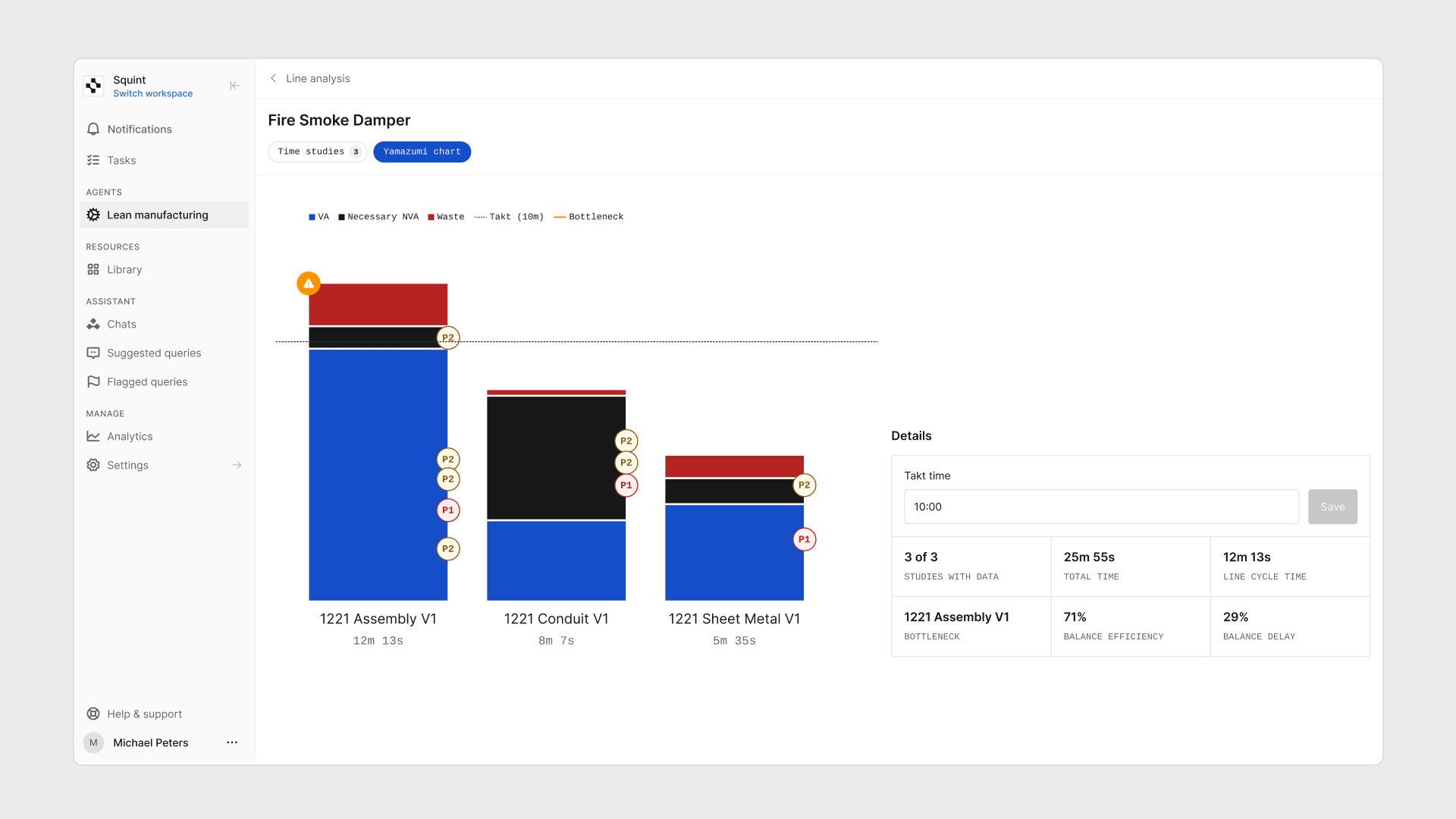
Every station feeds a line — several stations, several processes, strung together by dependencies. So the agent zooms, stacking each station's observed work against the takt time in a Yamazumi chart.
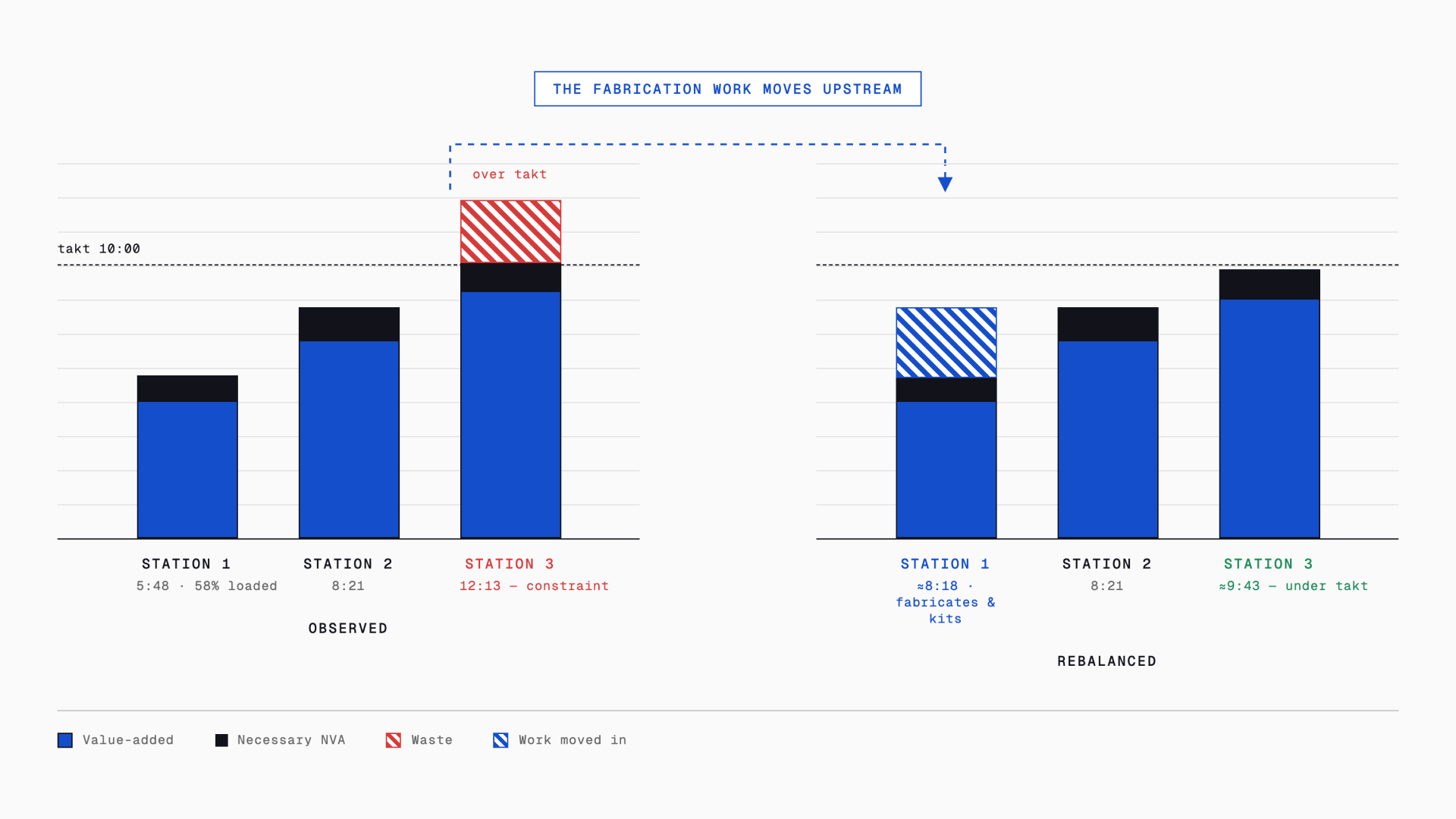
With takt time, dependencies, and constraints, the agent can hunt for independent work segments and find opportunities to balance the line. In the line above, the assembly station is over takt because the operator cuts and bends parts mid-cycle — so the agent's suggestion is to decouple the fabrication, pre-cut and kit the parts, and hand that work to the station sitting at 58% load.
But as every lean engineer knows: the bottlenecks will move. You make a change, and then there’s a new, slowest station. So the agent is tireless. It will continually observe the work on the floor and re-balance, based on your goal against your evolving constraints.
The plant
If you run a plant, you're already asking the hard question: “You found idle time. So what? Idle time might not be my constraint.”
Correct — and Goldratt would agree. The theory of constraints reaches all the way up to demand: what sales is actually selling, what inventory you're carrying, what raw materials cost and when they show up. Remove idle time on a line that's already building inventory and all you've created is a need for a bigger warehouse. Plant balancing requires deciding what each line runs and where the work goes, so throughput rises while operating expense and inventory fall together.
Nobody has ever truly done it (and not for lack of math). Arranging work optimally across stations is one of the hardest problems in computing (NP-hard, for the engineers reading). Manufacturers have bought software to try and solve it: discrete-event simulation, digital twins, planning systems. The problem with this approach is that all of it simulates. The inputs are estimates, because the real inputs have never been captured. The real inputs are in the observed work and in the tribal knowledge, both of which are undocumented and are walking out the door with every shift change.
Starting today, that’s no longer true. Squint's agent balances on actuals — the observed shop floor, not the theoretical one — and as it learns your demand and your economics, it recomputes for your goals. Materials are expensive and labor is cheap? Optimize for zero scrap. The line is sold out? Optimize for throughput and let idle time be. The same floor, with different goals, yields a different answer.
Why this didn't exist until now
Two things had to become true at once:
- The models. Watching long stretches of unscripted physical work and producing a gapless, second-by-second account of it, without narration, was not possible in any usable form two years ago. It’s a hard problem, and we've spent years in this space building something that works in real factories.
- The data. Squint is already the system where manufacturers author their procedures and run them on the floor. These procedures represent how work is supposed to happen, and document how it's executed every day. The agent compares intent against observation, which is why its analyses read like they were written by someone who knows your plant.
The continuous improvement loop
Here's the part that turns all of this into a system. Most improvement recommendations die in slide decks. But with Squint, you can close the loop:
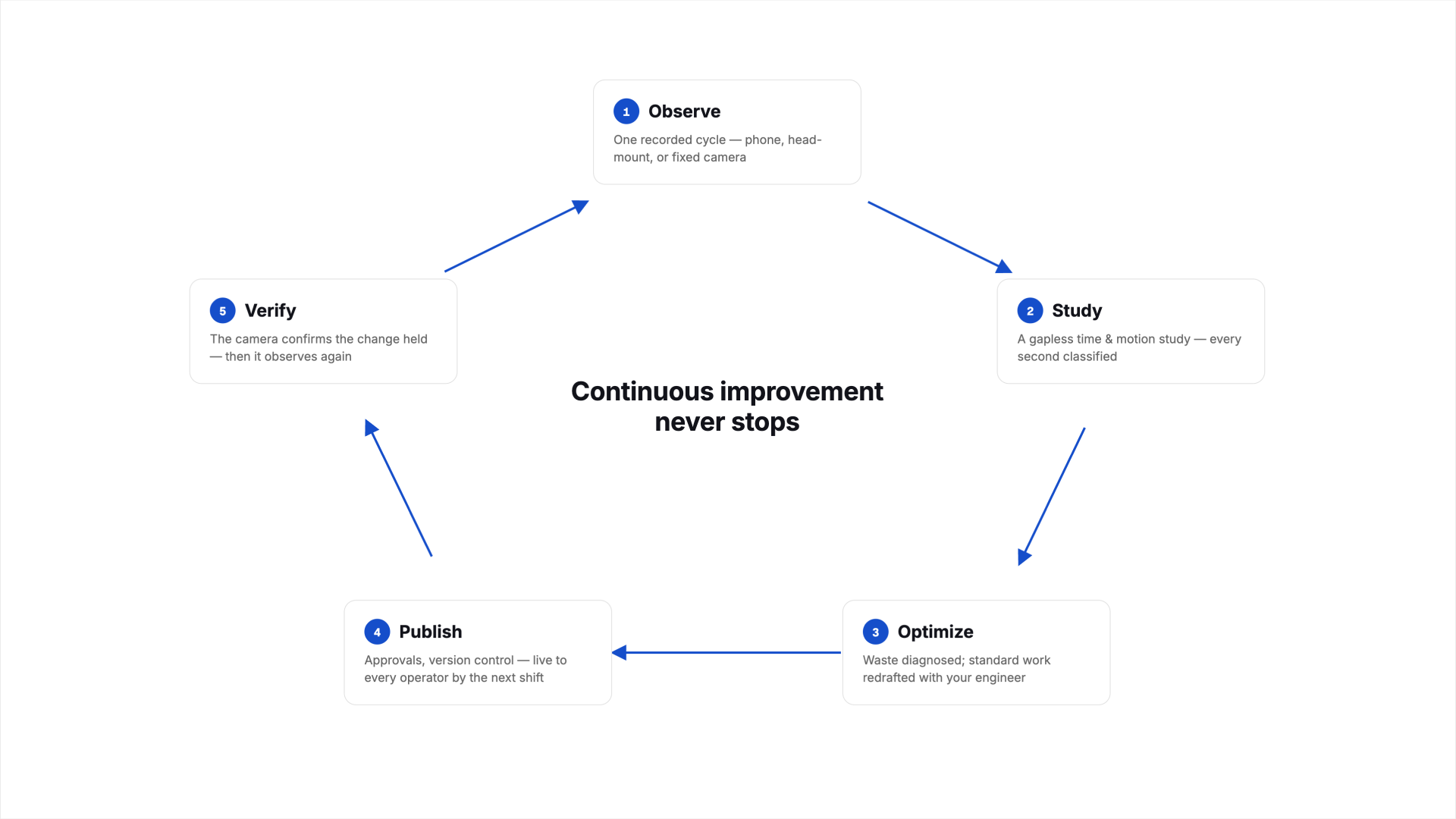
The agent drafts the improved standard work. You accept, modify, or reject, iterating with the agent. After you publish, it flows through your approvals and version control, and lands as work instructions in front of every operator by the next shift, with the changes highlighted. Squint verifies they're doing it the new way, trains them if they need support, and then observes again.
Every factory has one of these stories
Squint has always captured how work should be done and put it in operators' hands. The Lean Manufacturing Agent is the other half: watching how work is actually done, finding the gap, and closing it. It's the first of our industrial agents — the first bottleneck we're taking off a manufacturer's plate — with more coming behind it.
Taiichi Ohno called the underuse of people's talent the eighth waste. Every plant has people who can see the waste around them; almost none have the bandwidth to quantify it, prove it, and push the fix to the floor. Now they do.
Somewhere on your line, right now, there's capacity hiding in the wrong place. Deploy the agent and it'll find yours. See more at www.squint.ai/demo