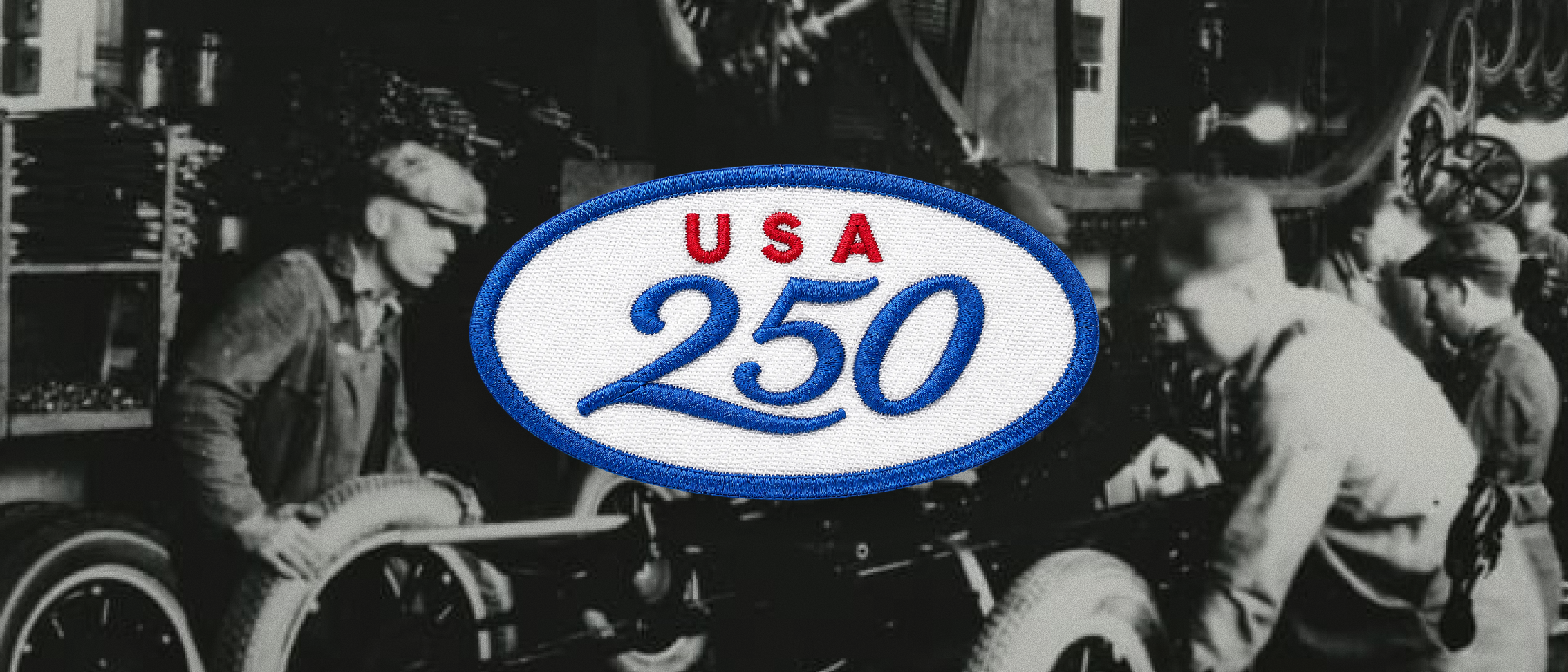
250 Years of Reinvention

As the United States marks its 250th birthday, I've found myself thinking about that tradition of reinvention, dare I say revolution, through the lens I know best — manufacturing.
In America, we’re wired to challenge the status quo, to question habit, to believe in something better. And for nearly two and a half centuries, manufacturing has been one of the clearest expressions of this American reinvention. We built railroads that connected a continent. We pioneered the assembly line. We helped define the age of steel, automobiles, aviation, semiconductors, and advanced robotics. Each generation inherited an industrial foundation and found a way to improve it, creating new industries and redefining what American manufacturing could become.
That continual reinvention — not any single invention or technology — is America's greatest competitive advantage. But it has never come easily. It has required pushing through doubt, seeing promise amidst fluff, and acclimating to strange, new technologies.
In fact, in every period of industrial reinvention, what enabled American industry to lead the world was a willingness to entertain change on the belief in something better. And today, we're standing at another one of those revolutionary moments.
Artificial intelligence has quickly become the defining technology of this generation. Yet at the same time, it's one of the most misunderstood, especially when it comes to manufacturing. Too often, the conversation begins with a false binary: either people do the work, or machines do.
But history tells a different story.
The greatest leaps in American manufacturing have never come from replacing workers. They've come from giving workers better tools.
Take electricity. When electric motors first reached the factory floor, most owners simply bolted them onto what they already had: one motor swapped in for the steam engine, still driving every machine through the same tangle of shafts and belts. New technology, but the same structure.
And for decades, productivity barely moved. The breakthrough came only when manufacturers rethought electricity on the floor entirely — giving each machine its own motor, controlled by the worker running it. With this change, now a single operator could start and stop on their own judgment. Machines could be arranged around the flow of the work rather than the reach of a driveshaft, and the floor itself got brighter, safer, and easier to move through. The reinvention came from better tools in the hands of the people doing the work — not from the electricity itself.
That's how American manufacturing has always moved forward. The assembly line didn't eliminate skilled operators, it made factories more productive. CNC machines didn't replace machinists — they expanded what machinists could build. Industrial AI ultimately belongs in that same tradition.
Despite our nation’s pedigree, the challenges we face today are real and urgent. China is investing aggressively to lead the next generation of manufacturing. At the same time, many of America's most experienced operators, technicians, and skilled tradespeople are nearing retirement, while too few workers are entering the pipeline behind them. Decades of hard-earned expertise is walking out the door — and too little of it is being passed on.
And yet, every week I leave factory floor visits more optimistic than when I arrived.
I have seen operators at automotive plants solving problems no manual could anticipate. I’ve met technicians at advanced manufacturing facilities who can hear when a machine isn't running quite right. And I see the appetite across American factory floors — teams that are hungry to learn, experiment, and constantly improve. That's why I believe the future of American manufacturing won't be determined just by who builds the smartest AI models. It will be determined by who puts them to work alongside the people who make the economy run.
For the first time, we have the ability to capture this industrial expertise, scale it across an organization, and put it in the hands of every worker. And it's already working. At one auto-parts plant, operators used AI to capture the right way to run a machine and standardize it across shifts — cutting scrap by 40%. At another facility, technicians with that guidance completed their work 76% faster than those without it. These aren't dream numbers from some future model. They're what happens when you empower a skilled workforce with the next generation of technology — and they’re emblematic of the enduring nature of American reinvention.
If we seize this moment with the same ambition that defined the generations before us, AI won't diminish American manufacturing. It will help write its next 250 years.