Off-the-Shelf AI Is Not Good Enough for Manufacturing

Every manufacturer is chasing Six Sigma efficiency and looking to AI for a boost.
But they’re running into a harsh reality: 70% accuracy is not good enough on a hot, loud factory floor where a hallucination could mean someone gets hurt or a defect wastes millions of dollars.
Manufacturing requires greater precision than an off-the-shelf LLM can provide.
Domain-specific Industrial Intelligence Platforms (IIPs) are more effective at leveling up factory efficiency than an off-the-shelf LLM.
Six Sigma Factory in the AI Era
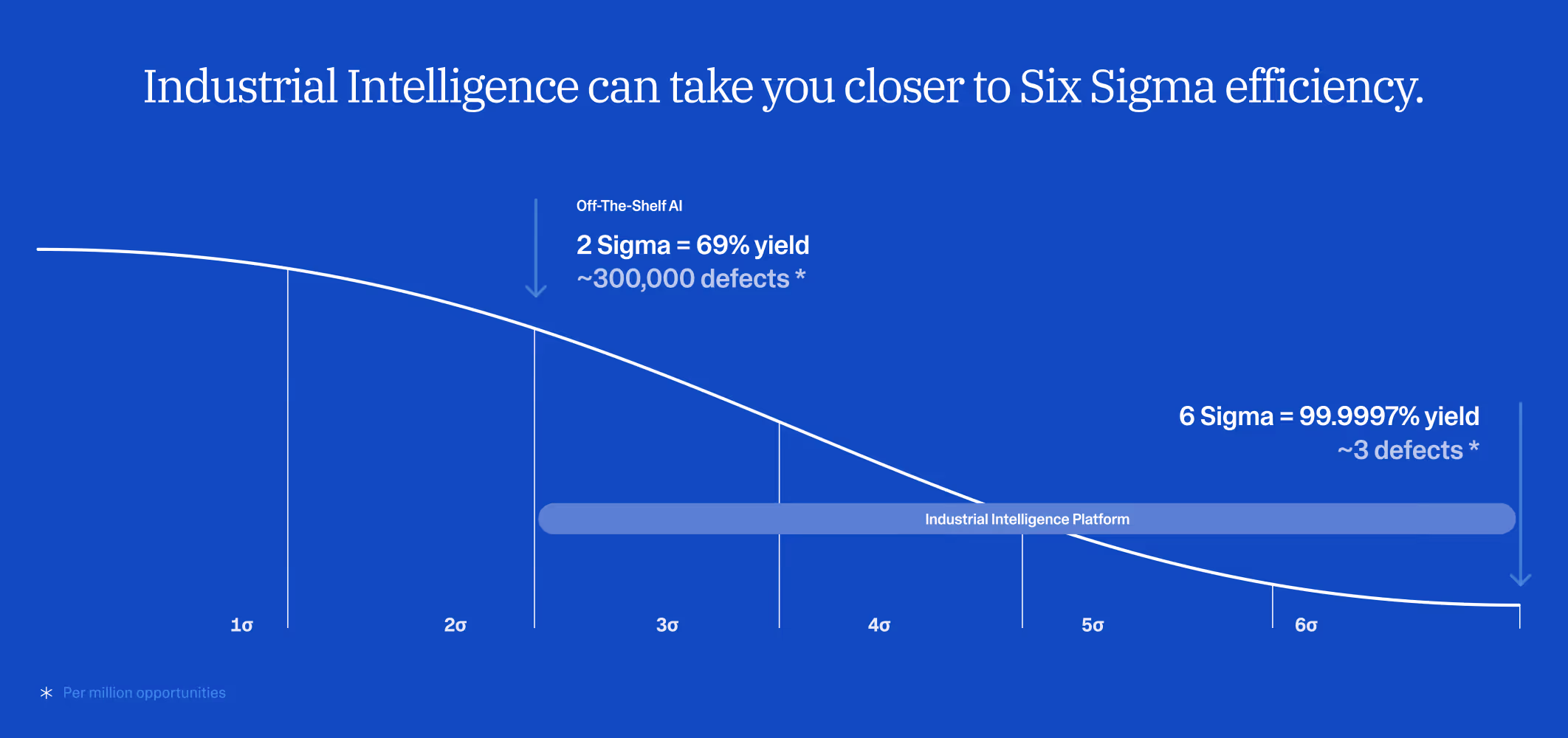
Every manufacturer cares about yield. The opposite of waste. So executives want their teams to get as close as possible to the Six Sigma factory — 99.9997% yield or about 3.4 defects per million opportunities.
Most leaders we talk to operate facilities around Three Sigma, or 93.319% yield. This is fairly efficient, but they feel a constant pressure to improve, as the difference between 93% and 94% could be hundreds of millions of dollars.
For decades, companies have used frameworks like continuous improvement, lean manufacturing, and Value Stream Mapping to analyze every step of every process to identify where there is wasted time or material, the primary drivers that impact overall yield.
And in theory, AI should be a gamechanger to help move closer to the Six Sigma Factory.
Off-the-Shelf AI Isn't Good Enough for Manufacturing
General‑purpose LLMs are great for consumer use cases and tend to deliver first-attempt task accuracy at about 70%.
That does not work for manufacturers! If you've put ChatGPT or Microsoft Copilot out onto the shop floor and gotten frustrated, you're not alone.
There are always glimpses of its potential, like when it gets something right on the first try and you think “Aha! This could help our operators and technicians troubleshoot repairs and reference work instructions!” But with enough testing, you’ve inevitably been let down. Because these models lack sufficient context from the systems, documentation, and tribal knowledge that come together to ensure standard work.
Other industries realize this and are developing domain-specific AI systems that perform better. If off-the-shelf AI is insufficient for document review (see Harvey) or for crop spraying (see John Deere’s See & Spray)... then of course it’s insufficient for manufacturing.
Our industry needs its own domain-specific context layer.
Intelligence for Industrials, Custom to Each Customer
Industrial Intelligence Platforms (IIPs) combine foundation models with a factory’s real operational context — IT systems, tribal knowledge, and standards of work — and deliver it to operators through consumer-grade product experiences.
An IIP is purpose-built for manufacturing, so it will get you closer to Six Sigma than an off-the-shelf LLM can.
IIPs Tap the Richest Source of Industrial Knowledge
Industrial Intelligence Platforms don’t only benefit from hyper-relevant context — they’re built to continuously learn about the execution and performance of a manufacturer. These systems learn directly from the richest source of industrial knowledge: the operator on the factory floor.
As operators review, edit, and perform AI-generated work instructions, they create a continuous feedback loop that can point supervisors to critical insights: where quality issues are happening, gaps in operator knowledge, and how procedures like changeovers and lockout/tagout are impacting throughput.
Over time, this process transforms day-to-day operational work into structured intelligence, steadily improving the system while prioritizing the most important outcome on the factory floor: getting the right answer, not just an answer.
True Manufacturing Advantage
Instead of introducing more room for error with an off-the-shelf LLM, IIPs standardize the best of human work and level up context-specific AI — saving time, minimizing waste, increasing yield, and helping operators and manufacturers move closer to the Six Sigma Factory.
That’s the future we believe in: purpose-built, domain-specific AI designed specifically for manufacturing. These systems combine foundation models with a customer’s manufacturing knowledge graph, built from generations of tribal knowledge, existing IT systems, and the standards of work that run the factory. Just as importantly, they are delivered through consumer-grade software that operators actually use.
When intelligence is grounded in real industrial knowledge and embedded directly into production workflows, AI stops being a generic tool and becomes a true manufacturing advantage.